Community · Oldham.news
One of UK's last clog makers Phil Howard to display at Clitheroe Castle after Saddleworth Rushcart
At Saddleworth's 50th Rushcart Festival, ex-dancer Phil Howard, one of Britain's last clog makers, showcased a critically endangered craft.
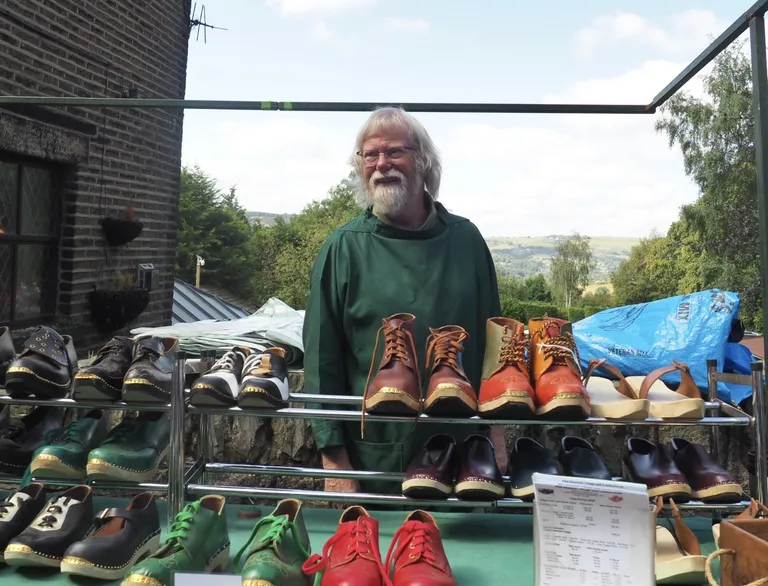
One of the last clog makers in Britain brought his trade to Saddleworth's 50th Rushcart Festival, warning that the craft is in danger of dying out.
Phil Howard, an ex-dancer turned clog maker, said only about five people in the UK make a business of it.
The Rushcart Festival is one of just two such events in the country. Morris dancers from across the UK gather to guide a 16ft tall, three-tonne cart through the villages before it reaches St Chad's Church in Uppermill. Thousands of visitors came to watch, many of the dancers wearing shoes made by Phil.
He started as a dancer in the early 1980s and gradually drifted into making clogs for his children, his wife and others.
British clogs are made from wood and leather, unlike the all-wooden shoes found in northern Europe. The upper is traditionally stitched by hand from several pieces of leather to look like an Oxford shoe. For Morris dancers, the sole is usually sycamore, which makes a loud sound when it hits the ground.
Step dancers tend to opt for plainer clogs because they are doing flashy steps, while Morris dancers go for more bling, he said.
All of the UK's clog makers are over 55, and Heritage Crafts, a national charity supporting traditional craft skills, lists clog making as critically endangered. The charity says makers struggle to access materials, particularly after Brexit and the Covid-19 pandemic.
Urban shoemakers find it harder to get workshop space as brownfield sites are developed for housing. Wood and leatherworking skills are also less accessible to young people: the number of design and technology teachers and students has more than halved, and 20 per cent of UK schools no longer teach the subject.
Phil described the difficulties of sourcing materials. The brass plates used on clog tips came from a firm that started in 1765 and closed decades ago, and no one makes clog irons anymore.
"I can still buy planks of wood, and I can still get leather, but it's not the same leather it used to be even five or six years ago," he said.
His output has halved since Covid because fewer people have taken up Morris dancing. He argues the future of the craft depends on demand as much as apprentices.
"Like everything else, the number of clog makers will contract or increase depending on demand. And if you come along and say, 'What am I doing about an apprentice taking over?' My reply is, 'What are you doing about increasing the demand?'"
Heritage Crafts says the only future for clogs is in orthopaedic footwear and dancing, a view Phil shares. He has also found other uses for his skills, including making shoes for Second World War reenactors and repairing leather luggage for Props House in Manchester.
Phil had dozens of people queuing at his Saddleworth stall and has no plans to stop. He will display his work at Clitheroe Castle on September 12 as part of the 2026 Lancashire and Cheshire ClogFest Championship.
He works from two workshops in his back garden, 20 seconds from home, and makes badges for teams from waste leather.
"I'd love if anyone would come along to me and say, 'You know, those clogs you supplied me with last week, I went out dancing, got home, and collapsed on the sofa, and then realised I'd still got them on as I hadn't noticed them'. I think that would be great," he said.