News · Oldham.news
Councillors refuse 68 affordable homes on Failsworth green belt
Oldham's planning committee has refused permission for 68 affordable homes on green belt land off Failsworth Road, against the developer's case.
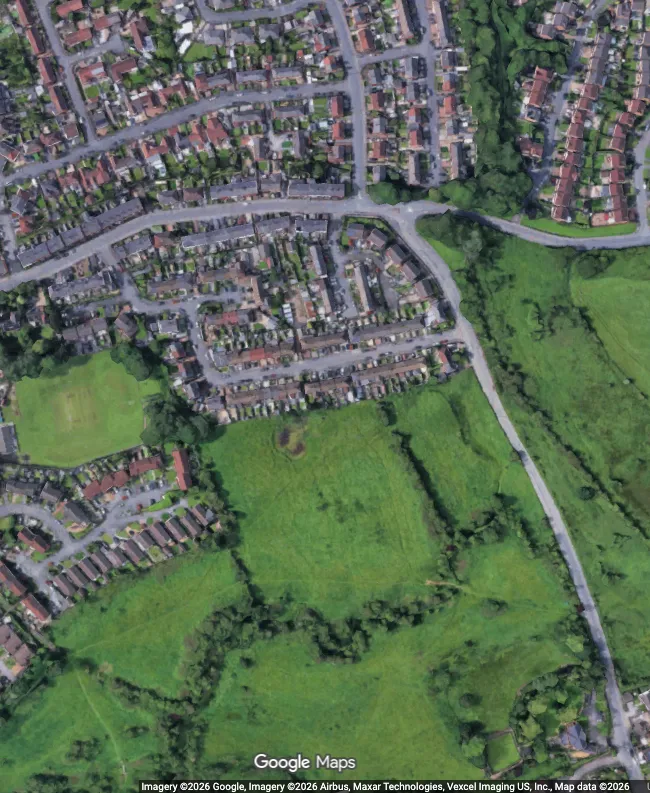
Oldham Council's planning committee has refused permission for 68 affordable homes on green belt land off Failsworth Road, in line with the recommendation of its planning officers. The developer had urged councillors to approve it.
The decision, taken at the committee's public meeting on Wednesday 23 September, was unanimous. Officers said it was possibly the first application to reach the committee where they had to assess whether a green belt site counts as "grey belt", a category set out in national planning policy, and the first since the government published a revised National Planning Policy Framework on 17 August.
The scheme from Redwaters Estates and Redwaters Fitfield (Failsworth) would have built 68 houses, all of them affordable, on 3.3 hectares on the west side of Failsworth Road. The northern half of the site would have been built on, with the southern half left open apart from the removal of invasive Himalayan balsam and some new tree planting.
The council lists the location as land off Failsworth Road, south of the homes on Argyll Park Road. The aerial image shows the surrounding fields, but not the application boundary. Check the red line in the officer report and site plan before drawing conclusions about which land was proposed for housing.
Planning officers recommended refusal for two reasons. The first is that the site, although assessed as grey belt, fails one of the tests national policy sets for building on grey belt, that the development meets an unmet need. The second is that the applicant had not shown the site could take adequate vehicle access from Failsworth Road.
What grey belt means here
Grey belt is a national planning category. It does not remove land from the green belt, and it is not a designation the council can apply on its own. Peter Richards, the council's assistant director for planning and development, explained the distinction to the committee: "it's not grey belt or green belt, the site is in the green belt. When you're considering developments in the green belt, we are now instructed through national policy to consider, is the site grey belt as well."
Grey belt land is green belt land that does not strongly contribute to the purposes that put it in the green belt in the first place. Even when a site is grey belt, it must also satisfy the other tests in the framework before it can be built on.
In a note added to the committee papers, officers set out how they reached that judgement. They concluded the site contributes only moderately to the purpose of checking the sprawl of large built-up areas, because Failsworth wraps around it on two sides. They found it makes no strong contribution to preventing neighbouring towns from merging, because the framework says that purpose is about towns and the nearest settlement, Woodhouses, is a village. And they found it makes no contribution to protecting the setting of historic towns, because the borough has no historic town. On that basis, the site is grey belt.
Where the application fell down was the unmet need test. The framework ties that test to two measures: whether the council can show a five-year supply of housing land, and whether its Housing Delivery Test result was below 75 per cent. The council's report states that Oldham has 6.36 years of housing land supply and that its 2025 Housing Delivery Test showed delivery running at 115 per cent between 2022 and 2025.
Mr Richards put the position to the committee bluntly: "the fundamental point, particularly right now, is that we don't need this site." He returned to it later in the debate: "even though it's grey belt, it is still inappropriate to develop in the green belt because we don't need that housing right now."
Six hundred objections and a six-year campaign
Steve Whitehead, a local resident and chair of the M35 Save Our Green Belt Group, told the committee the site was protected after a detailed assessment when the Places for Everyone joint plan was agreed, and that nothing material had changed since.
"For six years local residents have fought to protect this green belt. We marched, campaigned and engaged fully in the planning process," he said. "Now, only two years later, developers are asking you to overturn that decision through speculative application."
He told councillors there were "more than 616 formal objections to this application", and warned that approving it would weaken the case against a separate scheme nearby: "approve one scheme and it becomes harder to resist the next and then the next, and if you think about the cumulative impacts, before long the green belt across all them is under a sustained attack."
The Chair, Councillor Josh Charters, reminded the committee immediately afterwards that it could only weigh the merits of the application in front of it: "as per our training we have to only consider the merits of this application, so we can't bring the potential other application into our views today."
A separate application for up to 180 homes north of Woodhouses, from North Lumb Farm and worked up by the planning consultancy Pegasus Group, was submitted on 12 August and is being determined separately.
The applicant's argument: a housing crisis and 7,500 families waiting
Stephen Harris of Emery Planning, the agent for the applicant, argued the application was acceptable as a rural exception site, as grey belt, and, failing both, on the basis of very special circumstances.
He told the committee the only test the scheme failed was the housing supply one, and that the supply figure covers market and affordable housing together: "The only issue that we're falling down on that is because the council's got a six-year housing land supply. But the key thing there is that's a six-year supply of market and affordable housing."
He quoted the council's own declaration of a housing crisis in 2023: "too many Oldhamers are struggling to afford to keep a roof over their head. Too many Oldhamers live in substandard overcrowded housing. There are currently over 7,500 families on Oldham's social housing register, with almost 11,000 applications still being processed."
Mr Harris said six years of supply was only just above the five-year minimum the government requires, and closed: "if providing 68 family homes for people in affordable need in Oldham currently isn't a very special circumstance, I don't know what is."
The officer report answers that point directly. It accepts there is a need for more affordable housing in the borough, particularly for social rent, but says the sites in the council's housing land supply already include sites expected to deliver a significant amount of affordable and social rent housing. The contribution this scheme would make is "a material consideration that should be given some weight", the report says, but not enough on its own to outweigh the harm to the green belt.
What councillors said
Councillor Ken Rustidge, who represents Failsworth East for Labour and Co-operative, supported the officers' recommendation. "The harm this development will cause far outweighs any possible benefits that can be obtained from additional housing in this area," he said. He also raised traffic on the surrounding roads, telling the committee that residents had reported more vehicles turning from Failsworth Road onto Medlock Road, and that drivers appeared to be using the route as a rat run to avoid congestion on Oldham Road.
Councillor Andrew Barry Brooks, also Failsworth East, told the meeting he lives in Woodhouses. "This is not an argument against affordable housing, but it is where the reasonable brownfield options have been considered," he said. He raised the wildlife recorded on and around the site, including "crested newts, the deer that travel from the southern tip of Bury to South Manchester, owls, kestrels", drainage and flooding, ground conditions, pointing to council records of "post-glacial peat and alluvial deposits", the possibility of wartime munitions dumped under the land, and the fact that Woodhouses is a conservation area with "a single traffic road at either end of the village". He asked the committee to consider "whether there's sufficient evidence on the environmental and ecological value of this site" before deciding, and said: "we should not have to choose between affordable housing and protecting our environment."
Councillor Garth Harkness said the highway issues might be capable of being resolved, but that the concerns about the character of the land were not, and that in his view the proposal was "totally inappropriate development in the green belt".
The Chair also took issue with how grey belt is understood. He said people picture grey belt as "a bit of scrub land in the green belt that isn't necessarily valuable", but that this site is "well used open space in the ward" and "it's not a disused petrol station in the middle of a field, it's proper green belt".
Officers warned the committee about what it could and could not put in a refusal. When members discussed adding green belt wording to the reasons, Mr Richards advised against it: "I would urge you not to try and add something like that to the reasons for refusal." Officers were satisfied the site meets the grey belt criteria, he said, and a refusal reason that was clearly wrong could lead to costs being awarded against the council if the applicant appealed.
What happens next
The applicant can appeal to the Planning Inspectorate, which would put the decision in front of a government inspector rather than the council.
The committee's papers for the meeting, including the officer report on the Failsworth Road application, the late list of representations received after the report was published and the full agenda, are published on the council's committee website. Applications can be searched and commented on through the council's planning portal, and the council explains how to comment on an application on its main site. The video of the whole meeting is on the council's YouTube channel.
The committee's draft minutes will be published on the council's planning committee pages.